
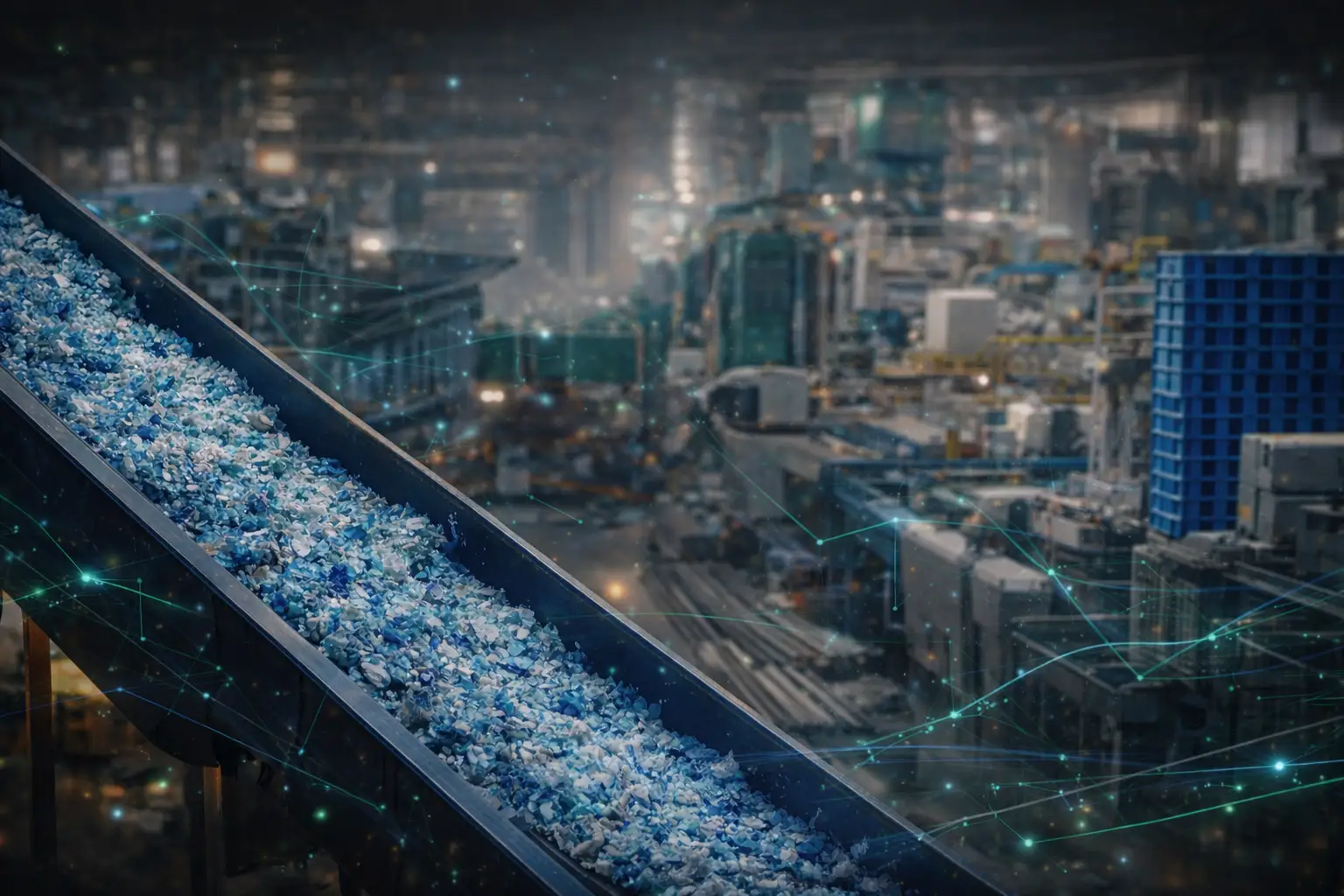
PMMA Recycling in the USA Complete Guide to Acrylic Sheet Scrap Offcuts Regrind Pellets and PCR
Poly methyl methacrylate, normally written as PMMA, is a transparent engineering thermoplastic used in acrylic sheet, signs, displays, lighting, skylights, automotive lamps, optical parts, sanitary products and molded components. U.S. manufacturers and fabricators generate clear sheet offcuts, routed skeletons, shavings, rejected signs, extrusion trim, runners, sprues, purges and obsolete inventory. These streams can have substantial value when polymer identity, color, coating and source remain controlled.
Acrylic is a commercial material name, not a complete recycling specification. Clear cast PMMA sheet, extruded PMMA, impact-modified molding resin, mirrored acrylic, coextruded sheet, PMMA capped ABS, filled solid-surface material and crosslinked dental resin do not behave as one grade. Transparent polycarbonate, PETG, polystyrene and SAN can also resemble PMMA. A recycler therefore needs source records, positive identification and a test plan before grinding a load into an irreversible mixture.
This guide explains how U.S. sheet fabricators, sign companies, molders, automotive suppliers, demolition contractors, recyclers, compounders and resin buyers can qualify PMMA for mechanical recycling or selected depolymerization routes that recover methyl methacrylate monomer. It covers post-industrial and post-consumer sources, cast and extruded acrylic, sorting, size reduction, washing, extrusion, optical testing, pricing, logistics, recycled-content claims, state opportunities and commercial due diligence. It also shows how WASTEMARKT can connect recurring acrylic supply with qualified buyers, machinery and freight providers.
What Is PMMA
PMMA is a thermoplastic polymer made primarily from methyl methacrylate, commonly abbreviated as MMA. At normal service temperatures it is rigid and transparent, with optical properties that make it useful as a glass substitute. Manufacturers supply sheet, rod, tube, film, molding pellets and specialty compounds.
Formulations can include impact modifiers, ultraviolet stabilizers, pigments, light diffusers, flame retardants, antistatic additives, mineral fillers or other comonomers.
PMMA can be formed by extrusion, injection molding, compression molding, thermoforming and casting processes. Sheet fabricators then saw, route, drill, laser cut, polish, bend, print, laminate and bond it. Every operation changes the recycling stream. Clean routed sheet skeletons may retain the original grade and color, while a finished sign can contain ink, vinyl film, adhesive, LEDs, wiring, aluminum frames and several clear polymers.
The material is recyclable when the processor has a technically and commercially valid route. Mechanical recycling keeps the polymer as polymer through grinding, melt filtration and pelletizing. Depolymerization converts selected PMMA feedstock back toward MMA for purification and reuse. Neither route accepts every object described as acrylic, and neither eliminates the need to identify coatings, additives, attached materials and prior service exposure.
PMMA Acrylic Plexiglass and Brand Names
PMMA and acrylic are the most useful generic terms for trade. Plexiglas, ACRYLITE, Perspex and Lucite are familiar names associated with acrylic products, but a brand name should not be used as a universal resin description unless the item is documented. A buyer still needs the grade, manufacturing method, color, thickness, surface treatment and source. The same branded portfolio can include products designed for different performance requirements.
In the Americas, POLYVANTIS markets PMMA sheet under the ACRYLITE brand, while other producers use their own names. Brand recognition can help trace original technical data, but it does not prove that a post-use piece remains uncontaminated or suitable for a specific new product. Listings should use the generic polymer first and add a brand only when markings, invoices or product records support it.
The phrase plexiglass recycling often attracts search traffic, but it can bring mixed transparent plastics. A recycler should train suppliers to distinguish a common name from verified polymer identity. The offer title can state PMMA acrylic sheet scrap, followed by cast or extruded, color, source and form. This wording is more precise than a broad load described only as clear plastic or plexiglass.
Cast Extruded and Molded PMMA
Cast acrylic sheet is polymerized in a mold between surfaces or produced through a continuous casting process. It is widely machined and thermoformed, and fabrication scrap can be thick, clean and highly transparent. Its molecular characteristics and residual chemistry differ from extruded sheet. A recycler should identify the producer and grade rather than assume that every cast offcut will feed or flow like standard extrusion pellets.
Extruded acrylic sheet begins with thermoplastic resin processed through a sheet die. Trim, start-up rolls, edge strips and rejected sheet may fit a direct mechanical route when color and formulation are controlled. Extruded sheet can carry masking film, coextruded layers, printing or surface treatments. Removing those additions before grinding protects optical quality and reduces screen changes.
Injection-molded PMMA appears in lenses, light guides, displays, housings, instrument components and consumer products. Runners and short shots from a known grade are often attractive feedstock because lot records and processing history are available. Impact-modified, heat-resistant, optical and flame-retardant grades should remain separate. A molded part that looks clear may also be PC, PETG, SAN or a blend.
PMMA Compared with Other Clear Plastics
Appearance alone cannot separate PMMA from polycarbonate, PETG, transparent polystyrene, SAN, PVC or specialty copolymers. These materials have different density, thermal behavior, chemical response and melt-processing windows. A small amount of the wrong clear resin can create haze, gels, brittleness, black specks or unstable extrusion in recycled PMMA.
Polycarbonate is a common contaminant in glazing, machine guards, lighting and automotive parts. PETG is used in displays, formed sheet and packaging. Clear PS and SAN appear in household products, appliances and displays. PVC can occur in signs, profiles, films and protective layers and is especially undesirable in a PMMA melt stream. Labels such as acrylic-like, unbreakable glass or clear plastic should never substitute for polymer verification.
Molded resin marks, supplier records, Fourier transform infrared spectroscopy, near-infrared sorting and thermal analysis can work together. Density or simple workshop observations may support screening but should not carry the final decision alone. Open-flame burn testing is unsafe and unreliable as a production identification method. A processor needs an instrumented procedure, reference samples and a route for pieces that remain unknown.
PMMA Recycling Market Context for the 2026 Edition
National U.S. plastics statistics rarely publish a separate PMMA recycling rate, and municipal programs generally do not manage acrylic as a high-volume curbside resin. The strongest commercial routes are source-specific industrial programs: sheet fabrication scrap, controlled sign-production waste, injection-molding rejects, automotive manufacturing parts and take-back systems that aggregate known acrylic products. Post-consumer recovery requires more dismantling and verification.
ASTM D7611 defines resin identification coding for manufactured plastic articles, but a code identifies resin and does not guarantee local recycling access. PMMA normally falls outside the six high-volume resin families and may appear within an Other category or through an additional resin abbreviation. Buyers should rely on the actual PMMA mark and technical records, not the number alone.
The U.S. EPA National Strategy to Prevent Plastic Pollution is under review as of this edition. Broader policy language does not establish an acrylic collection route or an end market. A credible PMMA program still depends on a defined generator, representative sampling, a capable processor, a valuable output and transparent downstream documentation. WASTEMARKT listings should keep general policy statements separate from evidence for the offered lot.
The Two Main PMMA Waste Streams
Post Industrial PMMA
Post-industrial PMMA is generated before a product reaches its intended user. Examples include clear and colored sheet offcuts, CNC skeletons, saw trim, drilling chips, rejected thermoformed parts, extrusion edge trim, runners, sprues, short shots, optical rejects, start-up material, purges and obsolete resin. Production records can identify grade, color, thickness, process, protective film, additive package and reason for rejection.
Factories create value by separating cast from extruded sheet, clear from colored material, molding grades from sheet, and standard PMMA from impact-modified or flame-retardant formulations. Chips carrying coolant, sweepings, laser-cut residue, adhesive-bearing parts and mixed maintenance scrap require their own codes. A clean offcut should not share a container with a finished sign or a PMMA capped ABS panel.
Post Consumer PMMA and PCR
Post-consumer PMMA has completed its intended use. Sources include signs, retail displays, lighting diffusers, skylights, machine guards, vehicle lamps, instrument lenses, furniture, aquariums, barriers and building products. These objects can contain weathered polymer, paint, printed graphics, vinyl film, adhesive, metal, LEDs, rubber seals, dust and other transparent plastics.
PCR acrylic describes the source history after use. It does not establish that the recovered fraction is pure PMMA or that optical performance has been restored. Buyers should request collection origin, dismantling and sorting procedures, analytical results, recovered yield, recycled-content calculation and the intended application. Outdoor service may require additional checks for yellowing, crazing, ultraviolet damage, chemical exposure and loss of impact performance.
Common Sources of Recyclable PMMA
Acrylic Sheet Fabrication and CNC Offcuts
Sheet distributors and fabrication shops generate some of the cleanest recurring PMMA streams. Saw strips, routed skeletons, drilled circles and rejected blanks can be segregated beside each workstation. The generator should record whether the sheet is cast or extruded, clear or colored, standard or impact modified, and whether it carries paper masking, polyethylene film, ink, adhesive or mirror backing.
CNC routing creates chips and dust with high surface area. Vacuum systems can collect the material, but tool wear, metal fines, wood dust and mixed jobs can contaminate it. Laser cutting may leave thermally affected edges and deposits. A buyer should inspect representative material from normal operations and understand the shop’s cleanout procedure before approving chips or fine powder.
Signs Displays and Visual Communication
Channel letters, illuminated signs, point-of-purchase displays, menu boards and exhibition components often combine PMMA with PC, PETG, PVC, aluminum, steel, wiring, LEDs, vinyl graphics and foam tapes.
Manufacturing offcuts can remain clean when the shop separates materials before assembly. Retired signs require dismantling and polymer identification before grinding.
Clear, white, opal and branded colors should be stored separately when the downstream market values color. Printed or painted sheet can suit an opaque compound but may fail an optical application. A seller should state whether graphics are removable, whether the sheet is mirrored or hard coated, and whether flame-performance claims were associated with the original product. Those claims do not automatically transfer to recycled resin.
Lighting Lenses and Optical Components
PMMA is used in luminaires, diffusers, lenses, light guides, illuminated panels and optical covers because it can provide high clarity and controlled light transmission. Production scrap may include transparent, frosted, prismatic, opal, diffusing and colored grades. Surface texture and additives that manage light are part of the formulation and can change the value of the recovered material.
Optical recycling programs need stricter control of haze, color, black specks, gels and other polymers. Mixing a diffusing white grade into clear PMMA destroys clarity even if both are chemically PMMA. Finished lighting products also contain LEDs, circuit boards, metal, sealants and wires. Dismantling should occur while components remain recognizable.
Automotive Lamps and Interior Parts
Automotive PMMA appears in rear lamp lenses, light guides, illuminated trim, instrument covers and decorative components. Manufacturing scrap can include runners, rejected lenses, painted bezels and assembled lamp parts. End-of-life lamps are more complex because they may combine PMMA lenses with PC, ABS, polypropylene, adhesives, sealants, metal and electronics.
Automotive material should be described by part family, vehicle or program when permitted, resin marking, grade, color, coating and assembly status. A red tail-lamp lens is not equivalent to a clear light guide, and a metallized decorative part should not be added to optical clear regrind. Reuse in a vehicle application requires the customer’s validation for weathering, optics, emissions, mechanical performance and regulatory requirements.
Building Glazing Skylights and Barriers
Acrylic sheet is used in skylights, domes, partitions, safety screens, machine guards, windows, canopies and architectural features. Fabrication scrap from new construction may be traceable. Removed building products can be weathered, dirty, cracked and attached to gaskets, aluminum, sealants, fasteners or protective coatings. Contractors should separate panels during dismantling rather than break them into a mixed construction container.
The collection plan should identify sheet type, service age when known, coatings, sealants, contamination and dimensions. Large panels consume trailer volume and can create sharp edges. Safe cutting or controlled size reduction may improve logistics, but shredding before inspection can hide PC, PETG and laminated products. A recycler should approve the preparation method in advance.
Injection Molding and Extrusion Factories
Injection molders generate runners, sprues, short shots, rejected lenses, housings and purges. Extruders generate edge trim, start-up sheet, profile cutoffs and off-spec rolls. Known-grade scrap can often return at an approved percentage after grinding, drying where required and testing. The plant must control heat history, particle size, dust, color and cleanout between resins.
Purges need separate evaluation because PMMA can degrade during long residence or excessive temperature and may contain the previous polymer or cleaning compound. Transparent applications reveal contamination that an opaque part might hide. Closed-loop regrind limits should be established through production trials, not copied from another grade or machine.
Sanitary Ware Composite Sheet and Solid Surfaces
Bathtubs, shower trays, spas, sinks and decorative surfaces may use acrylic as a cap over ABS, a filled casting resin, or a structure reinforced with glass fiber and resin. These products should not be marketed automatically as pure PMMA. The backing, filler, reinforcement and adhesive can dominate the mass and determine whether mechanical separation is practical.
Clean trim from a documented PMMA cap-sheet process can have a route when layers are disclosed and the buyer has suitable technology. Finished composite products require product-specific trials and a market for every separated fraction. Grinding a PMMA ABS laminate into a mixed flake may produce a usable blend for some compounds, but it cannot be sold as clear PMMA regrind.
Medical Laboratory and Dental Acrylic
PMMA appears in selected medical, laboratory and dental products, but these streams require careful distinction. Single-use devices may carry biological or chemical contamination and regulated handling requirements. Dental acrylic and UV-cured methacrylate resins can be crosslinked formulations that do not melt like standard thermoplastic PMMA sheet or molding resin.
A recycler should not combine healthcare or dental material with general clear sheet scrap based on appearance. The generator must identify the formulation, prior use, decontamination status and legal pathway. Reuse in a medical or food-contact application requires separate regulatory and customer review; the original product’s use does not confer approval on recycled material.
PMMA Material Forms Traded in the Market
Sheets Offcuts Parts and Skeletons
Whole offcuts preserve color, thickness, markings and evidence of coatings. They are easy to inspect but inefficient to ship when shapes trap air. Listings should show representative dimensions, maximum piece size, cast or extruded status, masking, print, adhesive and attached materials. Buyers should confirm whether pieces fit their shredder or granulator.
Bales and Densified Acrylic
Baling can improve freight economics for thin sheet and signs, but PMMA is rigid and brittle compared with film. Broken edges can puncture straps or liners, and compaction can hide contamination. Bale specifications should define dimensions, density, wire, maximum piece size, allowed colors, moisture and prohibited materials. Sampling should reach the interior.
PMMA Regrind Flake and Chips
PMMA regrind is size-reduced acrylic supplied within an agreed particle range. A useful offer identifies source, grade or product family, cast or extruded origin, color, protective film, coating, particle size, fines, bulk density, metal, other polymers, moisture and heat history. Chips and dust need special attention to contamination and safe handling.
Recycled PMMA Pellets and Compounds
Pelletizing can homogenize qualified regrind, improve feeding and remove limited solid contamination through filtration. It does not prove purity or optical quality. A recycled PMMA pellet specification should state recycled-content basis, formulation, melt-volume or melt-flow method, color, haze or transmission where relevant, volatiles, ash, mechanical properties and lot code.
Purges Lumps Powder and Sweepings
Purges and lumps can contain overheated polymer, previous resin, pigment and cleaning compound. Fine powder can concentrate dust, metal and foreign material and may create a combustible dust hazard. Floor
sweepings usually have lower value because traceability and contamination control are weak. These forms should remain separate from clean sheet offcuts.
How the PMMA Recycling Process Works
Receiving Source Review and Sampling
Receiving begins with supplier identity, product origin, photographs, grade information, prior use, process history and an incoming lot code. Inspect package exteriors and material from the top, center and bottom. Representative sampling must capture changes in color, thickness, coating and contamination. A hand-selected clear sample cannot represent a mixed trailer of retired displays.
Loads with liquids, unknown chemicals, biomedical contamination, batteries, lamps, pressurized items or excessive sharp hazards require quarantine and a documented disposition. The purchase agreement should define what the receiver may reject and who pays for return or disposal. Retained samples and photographs support later claim review.
Dismantling and Removal of Attached Materials
Finished products should be dismantled before fine size reduction. Aluminum frames, screws, steel clips, wires, LEDs, circuit boards, gaskets, foam tape, vinyl graphics and accessible labels are easier to remove while the product remains recognizable. Mirror backing, hard coats, printing and bonded laminate may require a dedicated route or acceptance as a lower-grade feedstock.
The processor should measure labor, recovery yield, equipment wear and the disposal cost of residual fractions. Dismantling is justified when it creates a consistent PMMA fraction and a market for the output. Breaking mixed products without a separation plan transfers cost downstream and can destroy otherwise recoverable acrylic.
Polymer Identification and Grade Sorting
Sorting can combine production records, molded marks, supplier labels, visual inspection, spectroscopy, density and thermal analysis. Near-infrared technology can identify many light-colored pieces, while black pigments, coatings, mirror layers and geometry may reduce sensor performance. A trial should use normal dirty material at expected belt loading.
First separate PMMA from other polymers. Then divide clear, translucent, white, standard colors and dark colors according to the buyer’s plan. Cast, extruded, molding and impact-modified grades may require separate streams. Unknown pieces should go to a tested mixed fraction rather than receive an unsupported PMMA designation.
Cutting Shredding Granulation and Dust Control
Large sheet may pass through a saw, shear or low-speed shredder before granulation. Knife condition, rotor speed, screen size and feed rate influence heat, fines, particle shape, power use and throughput. Brittle PMMA can fracture into sharp pieces. Equipment guarding, controlled feeding and suitable containers protect workers and prevent ejected fragments.
Routing chips and granulation fines create dust with a large surface area. OSHA identifies combustible dust as a workplace hazard across many materials and operations. Each facility needs a documented hazard assessment, ventilation, dust collection, housekeeping, ignition control and safe maintenance procedures matched to its material and equipment. Dust should not be blended into clean regrind simply to recover weight.
Metal Removal Air Separation and Optical Sorting
Magnets can remove liberated ferrous pieces, while eddy-current or other systems may recover nonferrous metal. Screens and air separation remove oversize, fines, paper and light film. Optical sorting can divide polymer and color when particle presentation is suitable. No single unit guarantees PMMA purity; the line must be validated as a connected process.
Mirrored sheet, printed flakes and pieces with masking can confuse sensors and change density or color readings. The processor should track false accepts and false rejects, sample sorted outputs and calculate mass balance. A visually clear flake can still be PC or PETG, while an opaque PMMA piece can be wrongly rejected if the system is trained only on clear samples.
Washing Label Removal and Drying
Washing can remove dirt, loose labels, paper, soluble residue and some adhesive. Chemistry, temperature, friction and residence time should match the source and wastewater system. Foam tapes, crosslinked adhesives, printing, hard coats and mirror backing may remain after a standard wash. The receiving specification should distinguish removable surface soil from bonded contamination.
PMMA is less hygroscopic than polyamide, but wet flake, wash water and trapped moisture can still cause processing defects and complicate volatile measurements. Drying conditions should follow the actual grade and extrusion process. Clean material must remain protected from rain, dust and cross-contamination after washing. Mass balance should record feed, clean flake, fines, labels, metal, sludge and rejects.
Mechanical Recycling Extrusion and Pelletizing
Qualified PMMA flake can be melt processed through controlled feeding, temperature, venting, filtration and pelletizing. Screens remove solid particles larger than the filtration level but cannot separate dissolved polymers or reverse thermal damage. Excessive residence time and temperature can increase yellowing, odor, bubbles and molecular-weight loss.
The compounder may blend compatible regrind with virgin PMMA, impact modifier, stabilizer, pigment or other approved additives. Every addition should be documented. Black color can hide visual contamination but does not improve polymer compatibility. A production record should capture feed formulation, temperatures, pressure, torque, vent condition, screen changes, output rate and pellet appearance.
Transparent end uses require tighter control than opaque parts. The extruder, conveying system, dryer and pelletizer need effective cleanout to avoid black specks and previous resin. The buyer should approve representative production pellets and finished test specimens rather than rely on a polished handful prepared outside normal operations.
Chemical Recycling and MMA Recovery
PMMA is one of the polymers for which depolymerization can recover methyl methacrylate under designed conditions. Thermal, catalytic and other research routes aim to improve monomer yield, purity and operating temperature. Industrial feasibility still depends on feedstock identity, additives, coatings, contamination, energy use, emissions control, purification and a customer for recovered MMA.
Clean production sheet and molding scrap can be more suitable than mixed construction or composite acrylic. PVC, flame retardants, adhesives, fillers, pigments and other polymers can create unwanted products or purification load. A supplier should verify the facility’s actual feed specification and acceptance test instead of assuming that any acrylic waste can become virgin-equivalent monomer.
Recovered MMA is an industrial chemical with different safety and transport considerations from solid PMMA scrap. OSHA publishes chemical data for methyl methacrylate, including flammability information. Facilities that depolymerize, purify, store or repolymerize MMA need process-specific engineering, exposure, fire, environmental and regulatory controls. A plastics marketplace listing should distinguish solid PMMA feedstock from recovered monomer.
Testing Lot Release and Retained Samples
Lot release should connect incoming source, sorting and processing records with final results. Typical checks include polymer identity, color, luminous transmission, haze, thermal behavior, melt volume or melt flow, density, moisture or volatiles, ash, metal, black specks, other polymers and mechanical properties. Residual monomer, odor, weathering or chemical screening may be needed for a specific use.
ASTM D1003 is a recognized method for haze and luminous transmittance of transparent plastics, but the customer must define specimen preparation and acceptance limits. Test reports should name the method, condition, units, result, specification and lot. Retained samples help determine whether later variation came from the supplied batch, storage or the buyer’s process.
Quality Specifications Buyers Should Request
A PMMA specification should describe the material the next process can accept and the evidence needed for release. Clear acrylic, clean plexiglass and recycled PMMA are not measurable grades. Limits should be established through source review, laboratory testing and a representative production trial. Optical requirements should be separated from general mechanical-recycling requirements.
| Specification field | What to define | Why it matters |
Source and product | Named factory, sheet process, sign, lamp, molded part or post-use collection | Predicts grade, additives, exposure and traceability |
PMMA identity | Verified PMMA percentage and accepted copolymers or blends | Controls compatibility and truthful description |
Manufacturing family | Cast sheet, extruded sheet, molding grade, impact modified or specialty PMMA | Affects flow, properties and end use |
| Specification field | What to define | Why it matters |
Color and optics | Clear, opal, white, standard color, transmission, haze and color limits | Protects optical and color applications |
Physical form | Offcuts, parts, bale, chips, regrind, flake, powder or pellet | Determines handling and preparation |
Particle range | Screen size, oversize, fines and bulk density | Controls feeding, dust and freight |
Surface materials | Masking, print, paint, adhesive, mirror backing, coating and allowed percentage | Predicts defects and filtration load |
Other polymers | Limits for PC, PETG, PS, SAN, PVC, ABS,PE film and unknown plastic | Reduces haze, gels and degradation |
Metal and foreign matter | Ferrous, nonferrous, glass, rubber, paper, wood and prohibited items | Protects equipment and product quality |
Melt behavior | Method, temperature, load, preconditioning and approved range | Tracks grade consistency and thermal history |
Moisture and volatiles | Sampling method, maximum result, packaging and drying responsibility | Reduces bubbles, odor and variation |
Ash and additives | Maximum ash and known filler, diffuser or flame-retardant package | Identifies formulation changes |
Recycled content | Post-industrial and post-consumer percentages with mass-balance basis | Supports claims and customer records |
Lot and change control | Batch code, retained sample, notification and requalification triggers | Keeps recurring supply predictable |
Tests That Matter for Recycled PMMA
Polymer Identity and Composition
Spectroscopy can confirm PMMA and screen common clear-plastic contaminants. Thermal analysis can support identification of polymer transitions, degradation and filler. Results should be compared with known reference materials and the intended formulation. Mixed regrind requires a sampling plan because one clean flake does not represent the package.
Melt Flow Thermal History and Volatiles
Melt-volume rate or melt-flow rate can help track processability when temperature, load and preconditioning are fixed. A change may indicate another grade, molecular-weight loss, moisture or contamination. Volatile or residual-monomer testing may be important for odor-sensitive, thick-section or optical applications.
Processing trials should record pressure, torque and surface defects.
Optical Color and Surface Quality
Transparent applications may require luminous transmittance, haze, yellowness or color coordinates, black-speck counts and visual inspection under controlled lighting. Specimen thickness and preparation change the result. A clear pellet does not guarantee a clear molded plaque, and a polished plaque may conceal contamination that appears during long production runs.
Mechanical Heat and Weathering Performance
Tensile, flexural, impact, Vicat softening, heat-deflection and dimensional tests can be selected for the next product. Outdoor applications may require accelerated weathering and comparison with a control. Recycled content does not replace application validation. The customer defines which properties are critical and how samples are conditioned.
Contamination Ash and Metal
Ash measures noncombustible residue but does not identify every contaminant. Microscopy, filtration residue, elemental analysis, magnets and metal detection may be added. Buyers should define maximum PC, PETG, PVC, ABS, paper, film, adhesive and coating because each produces different failure modes. A pass requires both the numerical limit and the agreed sampling method.

Applications for Recycled PMMA
Qualified recycled PMMA can be used in opaque or colored sheet, displays, profiles, housings, trays, decorative products, lighting components and molded goods when the formulation meets the application’s requirements. Clear optical uses demand strong control of polymer purity, color, haze, volatiles and black specks. Lower-grade mixed color may fit black or opaque compounds after validation.
Mechanical recyclate often enters products whose optical and mechanical requirements match the available quality. Depolymerized and purified MMA can support new PMMA production when the recovered monomer meets the producer’s specification. The term closed loop should be reserved for a documented system in which material returns to the same or a comparable product pathway, with yield and recycled-content accounting stated clearly.
No recycled grade is universal. Signs, vehicle lamps, building products, medical devices, food-contact components and safety glazing have different customer and regulatory requirements. The recycler should sell a defined raw material with evidence, and the manufacturer should validate the finished product under actual processing and service conditions.
Common Contaminants and Failure Modes
| Contaminant or variation | Likely effect | Control |
PC PETG PS or SAN | Haze, gels, brittleness, flow variation or poor optics | Source separation, spectroscopy and representative sampling |
PVC | Thermal instability, corrosive byproducts, odor and severe quality loss | Strict exclusion, identification and supplier controls |
| Contaminant or variation | Likely effect | Control |
PMMA capped ABS | Opaque mixed composition and incorrect pure PMMA claim | Disclose layer structure and use a designed blend route |
Protective film and labels | Gels, smoke, odor, carbon and filtration pressure | Remove before grinding or set a measured limit |
Adhesive foam tape and sealant | Volatiles, black specks, deposits and weak parts | Dismantling, washing and source-specific acceptance |
Mirror paint and hard coat | Ash, color, flakes and optical defects | Separate grades or qualify for opaque applications |
Mixed colors and diffusers | Unstable shade, reduced transmission and haze | Color sorting and controlled blend recipes |
Metal glass and mineral | Equipment damage, ash and surface defects | Dismantling, metal separation and inspection |
Weathering and overheating | Yellowing, crazing, odor and molecular-weight loss | Source history, optical tests and production trial |
Dust and fine chips | Handling loss, contamination and combustible dust risk | Closed collection, housekeeping and separate grade |
Why Clear Material Can Still Fail
Clear appearance is only a visual snapshot. PC, PETG and SAN pieces can be transparent, and a thin coating may be invisible until extrusion. Molecular degradation, residual stress and ultraviolet exposure can also remain hidden. Approval should combine identity, processing and finished-specimen tests rather than use transparency as the acceptance criterion.
Why Grinding Too Early Reduces Value
Whole parts and offcuts reveal markings, layers, hardware and source. Once mixed products become small flake, separation becomes more expensive and some evidence disappears. Generators should segregate at the work cell, dismantlers should remove attachments, and recyclers should inspect before fine grinding. This order protects higher-value clear and single-grade streams.
How to Buy Recycled PMMA
Begin with the finished product and the process that will make it. Define accepted PMMA families, cast or extruded origin, color, optical properties, melt method, other polymers, coatings, adhesives, metal, particle size, volatiles and recycled-content evidence. Request a representative sample taken from routine production. Hand-picked clear flakes do not show normal package variation.
A production trial should record blending percentage, drying, temperatures, pressure, torque, screen changes, output, cycle time, color, haze, black specks, surface appearance and finished-part tests. Approval should be linked to supplier, site, source, sorting process and formulation. Changes in original sheet, product family, masking, coating, equipment, subcontractor or feed mix should trigger notice and possible requalification.
Commercial terms should define quantity tolerance, packaging, net weight, delivery term, inspection period, sampling, test hierarchy, claim window, rejected-load procedure and responsibility for freight or disposal.
Buyers should verify company identity, facility capability and relevant environmental authorization. International movements require separate customs and waste-classification review.
How to Sell PMMA More Effectively
Use an offer title that combines polymer, source, form and the most important differentiator. Clear post-industrial extruded PMMA sheet offcuts with removable PE masking is more useful than acrylic scrap. Red molded automotive PMMA runners from a controlled lamp program describes a different market. If the material is a verified blend or capped sheet, state that directly.
A complete listing should state source, original process, post-industrial or post-consumer status, cast or extruded origin, grade, color, coating, masking, contamination, particle size, heat history, tests, monthly quantity, minimum order, package, location and delivery basis. Photographs should show typical pieces, package interiors, regrind close-ups and normal contamination.
Recurring factory programs usually carry more value than isolated mixed loads because the buyer can qualify the process and plan capacity. Generators improve value by separating at the machine, keeping clear and colors apart, removing film and hardware, controlling grinder cleanout and notifying buyers before product or material changes.
What Determines the Price of Recycled PMMA
PMMA scrap and recyclate prices move with virgin resin and MMA conditions, demand in sheet, signs, lighting and automotive markets, energy, labor and freight. Within the same market, value depends on source, polymer certainty, cast or extruded family, color, optical quality, contamination, processing level, lot consistency, quantity and approved end use. Clear production offcuts should not be priced against mixed demolition acrylic.
Yield is as important as purchase price. A low-cost retired-sign load can become expensive after frames, vinyl, LEDs, adhesive, other polymers and disposal are deducted. Fine chips may be clean polymer but costly to handle and filter. Buyers should calculate delivered cost per usable pound, including sampling, dismantling, sorting, grinding, washing, drying, extrusion, yield loss and claims.
Every price reference should state grade description, location, currency, unit, delivery basis, quantity and date. WASTEMARKT Price Index content can add context when observations are tied to defined grades such as clear post-industrial extruded sheet offcuts, sorted cast acrylic scrap or approved recycled PMMA pellets.
Mixed clear plastic is not a stable PMMA index grade.
Logistics and Packaging for PMMA
Large sheet and routed skeletons reach trailer volume before legal weight. Controlled cutting, nesting or approved pre-shredding can improve freight economics when it does not hide contamination. Sharp broken edges require strong packaging and safe loading. Buyers should state maximum piece size and whether stacked sheet, gaylords, bales or loose parts are acceptable.
Regrind and pellets are commonly packed in lined gaylord boxes, supersacks or bulk systems selected for particle size, dust and unloading equipment. Every package should carry material code, lot, net weight and package number. Liners protect against dirt and moisture and prevent fine chips from escaping. Damaged packaging should be photographed and reported at receipt.
Before dispatch, buyer and seller should confirm truck type, pallets, loading hours, scale documents, seal procedure and unloading method. Cross-docking can consolidate smaller fabricators only when lot identity remains intact. Combining clear cast sheet, colored molding scrap and post-consumer signs into one outbound lot may reduce value more than the freight saving.
Operating Controls for Factories That Generate PMMA Scrap
A factory program begins with a material map. List each saw, router, laser, thermoformer, extruder and molding press with resin code, grade, color, product, expected volume, normal contamination and current disposition. Assign labeled containers to approved streams. Mirror acrylic, capped sheet, purges, dusty chips, assembled rejects and unknown material need separate routes.
Protect scrap at the point of generation. Covered containers prevent dust, rain and mixed waste. Grinder-cleaning procedures should identify the previous material and the disposition of first material after changeover. Where regrind returns internally, the plant should control maximum addition, heat history, particle size, fines, test frequency and traceability to finished production.
Track scrap by weight and cause. Useful measures include scrap per production unit, segregation errors, clear-grade recovery, contamination claims, usable yield, screen-change frequency, freight per pound and net recovery value. Review recurring defects with production and quality teams. Preventing rejected optical parts often creates more value than recycling them after the fact.
Machine guarding, lockout, ventilation, dust collection and housekeeping should match sawing, routing, grinding and conveying. PMMA pieces can be sharp, and fine dust can create workplace risk. Each facility should complete its own hazard analysis, training and preventive-maintenance program instead of relying on the material’s ordinary solid form as proof that every operation is safe.
Commercial and Environmental Due Diligence
Verify the counterparty’s legal name, operating address, authority to contract, facility type and relevant permits or registrations. Confirm who owns the material and which broker, transporter, sorter, washer, compounder or depolymerization facility will handle it. Copied photographs, inconsistent addresses, sudden bank changes and pressure to pay before sample approval require resolution.
Technical review should cover source control, PMMA identification, color sorting, dismantling, dust management, washing, extrusion, test methods, calibration, lot coding, retained samples, complaints and capacity. Environmental review should address dust, wastewater, ink, adhesive, removed electronics, metal, rejected loads and downstream disposition. EPA’s legitimate-recycling principles are directly relevant when hazardous secondary material is involved and useful as a due-diligence framework for confirming a real product and market.
For food-contact, medical, building, automotive or safety uses, recycled PMMA requires application-specific review. The original product’s approval does not transfer automatically through recycling. The manufacturer should evaluate source, process, contamination, composition, performance and all current federal, state, customer and industry requirements for the finished product.
Recyclable and Recycled Content Claims
Technical recyclability does not mean that consumers can place acrylic in every curbside bin. The FTC Green Guides advise qualifying recyclable claims when appropriate facilities are not available to at least 60 percent of consumers or communities where the product is sold. PMMA often depends on industrial take-back or specialized collection, so marketing should describe the actual pathway and geographic limitation.
The FTC also states that recycled-content claims apply to material recovered or diverted from the waste stream during manufacturing or after consumer use. Products made partly from recycled material should state the percentage. Companies should distinguish post-industrial and post-consumer PMMA and document the calculation basis, product scope, allocation method and verification.
Claims such as 100 percent recycled acrylic, closed loop, recyclable, optical grade, food-contact suitable, automotive grade or recovered MMA require separate evidence. A monomer-recovery claim should state the feedstock, process boundary, yield and how recovered content is assigned to the new product. Publishers should date regulatory references and obtain qualified review for the exact product and jurisdiction.
Designing Acrylic Products for Better Recycling
Design teams should identify the intended recovery route while choosing resin, color, coating, masking, adhesive and attachments. Clear PMMA markings, accessible fasteners and separable frames improve dismantling. Avoiding unnecessary clear-polymer combinations, permanent foam tape, inseparable electronics and dark printing can preserve recycling options when performance permits.
Signs and lighting products can support recovery through modular LEDs, removable graphics and documented material families. Automotive lamps can benefit from accessible joining and component identification. Sheet fabricators can standardize scrap codes and arrange take-back before production starts. Product records should survive long enough to help a future dismantler distinguish PMMA from PC and PETG.
Products must still meet safety, optical, weathering, fire and durability requirements. Design for recycling must work with those requirements. A pilot should include collection, dismantling, identification, size reduction, processing and a defined next product. A resin choice without a practical collection system and a buyer is not a complete recovery plan.
Regional Opportunities Across the United States
PMMA recycling opportunities follow sheet distribution and fabrication, sign production, automotive and lighting manufacturing, building renovation, retail-display production, injection molding and access to
engineering-plastics recyclers. The ten states below are priority geographies in the WASTEMARKT U.S. SEO program. They are commercial starting points, not claims that every local recycling program accepts acrylic.
Each state page should identify current generators, processors, freight lanes, take-back programs and regulatory requirements. Local verification is important for construction material, electronics, medical products, dust, wastewater and consumer recyclability claims. Pages should be updated as facilities, policies and downstream markets change.
| Priority state | Likely PMMA supply opportunities | Commercial focus |
Michigan | Automotive lamps, optical components, molding scrap and industrial signs | Grade-specific factory programs and automotive validation |
Ohio | Sheet fabrication, lighting, automotive suppliers, retail displays and molded parts | Recurring collections and Midwest processing |
Texas | Signs, building products, lighting, industrial guards and fabrication scrap | Large-volume aggregation and Gulf logistics |
California | Signs, technology displays, building renovation, retail fixtures and specialty molding | Traceable collection and qualified end markets |
Georgia | Automotive suppliers, lighting, signs, displays and construction acrylic | Source-separated Southeast factory routes |
Illinois | Industrial guards, sheet distribution, displays, lighting and injection molding | Aggregation, sorting and approved buyers |
New York | Retail displays, signs, architecture, events and building renovation | Dense collection routes and dismantling |
New Jersey | Sheet fabrication, specialty compounding, lighting and imported displays | High-value sorting and technical documentation |
Florida | Signs, marine glazing, retail fixtures, skylights and building products | Weathered-material controls and backhaul |
Louisiana | Industrial glazing, signs, marine applications and Gulf Coast construction | Project recovery, contamination control and freight |
How WASTEMARKT Connects the PMMA Supply Chain
WASTEMARKT can connect sheet producers, distributors, fabricators, sign companies, lighting and automotive suppliers, recyclers, compounders, manufacturers, traders, machinery suppliers and logistics providers.
PMMA listings should include source, cast or extruded family, grade, color, masking, coating, contamination, particle size, tests, volume, frequency, package, location and delivery basis.
Verified company profiles and traceable documents help buyers compare counterparties. Machinery listings can support cutting, shredding, granulation, metal separation, optical sorting, washing, drying, extrusion,
filtration and pelletizing. Logistics pages can connect stacked sheet, bales, gaylords, supersacks and container loads with suitable carriers and cross-docking. Price Index content can provide context when every observation is tied to a defined acrylic grade.
Frequently Asked Questions About PMMA Recycling
Is PMMA recyclable
Yes. Clean, identified PMMA can be mechanically recycled, and selected streams can be depolymerized toward MMA monomer. The route depends on grade, color, coatings, contamination and end market.
Are PMMA and acrylic the same
PMMA is the polymer used in many products called acrylic. Acrylic is a broader commercial term, so buyers should still confirm that a scrap load is PMMA and identify its grade and construction.
Can plexiglass be recycled
Products commonly called plexiglass may be recyclable through a specialized acrylic route. The recycler must verify PMMA identity and remove incompatible plastic, film, adhesive, metal and electronics.
What is the difference between cast and extruded acrylic
They are produced differently and can have different molecular and processing characteristics. Recyclers should identify the sheet family and qualify it for the intended mechanical or monomer-recovery process.
Can clear acrylic go in curbside recycling
Usually not through ordinary curbside programs. PMMA commonly requires a specialized industrial or take-back route, and local acceptance should be checked before making a recyclable claim.
Can PMMA and polycarbonate be recycled together
They should normally be separated. Both can look transparent, but their melt behavior and properties differ, and mixing can cause haze, brittleness, gels and processing instability.
Can PETG contaminate PMMA regrind
Yes. PETG is common in clear displays and formed sheet. Even visually clean pieces require polymer identification when PMMA and PETG are handled at the same facility.
What is PMMA regrind
PMMA regrind is size-reduced acrylic scrap. A useful specification states source, cast or extruded family, color, particle range, film, coating, contamination, volatiles and processing history.
Can mirrored acrylic be recycled
It may fit a dedicated or opaque route, but mirror coatings and backing affect ash, color and filtration. It should not be mixed automatically with clear optical PMMA.
Can PMMA ABS sheet be sold as acrylic
The acrylic cap should be disclosed, but the complete sheet is a PMMA ABS structure. Ground laminate is not pure PMMA and needs a buyer that has approved the blend.
Can automotive tail lights be recycled as PMMA
Some lenses contain PMMA, but lamp assemblies also use PC, ABS, PP, adhesives, sealants, metal and electronics. Dismantling and grade identification are required before recycling.
Can acrylic signs be recycled
Yes, when PMMA is separated from frames, vinyl, printing, LEDs, wire, foam tape and other clear plastics. Manufacturing scrap is usually easier to qualify than retired signs.
Can PMMA be recycled back to MMA
Selected PMMA streams can be depolymerized and the recovered MMA purified. Feedstock composition, yield, impurities, energy, emissions and monomer specification determine commercial suitability.
Which tests matter for recycled PMMA
Typical controls include polymer identity, color, haze, transmittance, melt behavior, volatiles, ash, contamination, black specks and mechanical properties. The next application defines the final test plan.
Does washing make mixed clear plastic into PMMA
No. Washing removes surface contamination but does not identify PC, PETG, PS, SAN or PVC and cannot reverse polymer degradation.
What determines recycled PMMA price
Price depends on source, PMMA certainty, cast or extruded family, color, optical quality, coatings, contamination, processing level, consistency, volume, location, usable yield and freight.
How should acrylic scrap be packaged
Stack large offcuts safely or use suitable gaylords, bales or lined supersacks. Label every package by material and lot, control sharp edges and keep chips, dust and pellets contained.
Is PMMA dust combustible
Fine polymer dust can present a combustible dust hazard depending on particle size, concentration and conditions. Facilities need a site-specific hazard assessment, dust control, housekeeping and ignition prevention.
How can a factory sell recurring PMMA scrap
Map each stream, separate by grade and color at the workstation, remove attachments, control grinder cleanout, record monthly volume, provide representative samples and notify buyers before changes.
Where can companies find PMMA buyers and recyclers
Companies can publish detailed offers on WASTEMARKT to reach acrylic recyclers, compounders, sheet and molding producers, traders, machinery suppliers and logistics providers.
Conclusion Building a Reliable PMMA Raw Material Stream
PMMA recycling in the United States works best through source-specific programs. Clear cast sheet, extruded trim, molded optical parts, colored signs, automotive lamps, capped ABS and post-consumer building acrylic have different processing and contamination risks. Dependable programs identify material before grinding, remove attachments, isolate incompatible clear plastics, control dust and test the properties that matter to the next process.
Buyers should approve material on delivered usable cost and proven manufacturing performance. Sellers gain value when source, grade family, color, coatings, test data, quantity and logistics are transparent. WASTEMARKT can make these acrylic streams visible to qualified counterparties and connect material trade with machinery, logistics, pricing and company verification.
BUY | SELL | CONNECT
List acrylic sheets offcuts signs molded parts regrind pellets and PCR PMMA on WASTEMARKT
Register and add your offers at www.wastemarkt.com


