
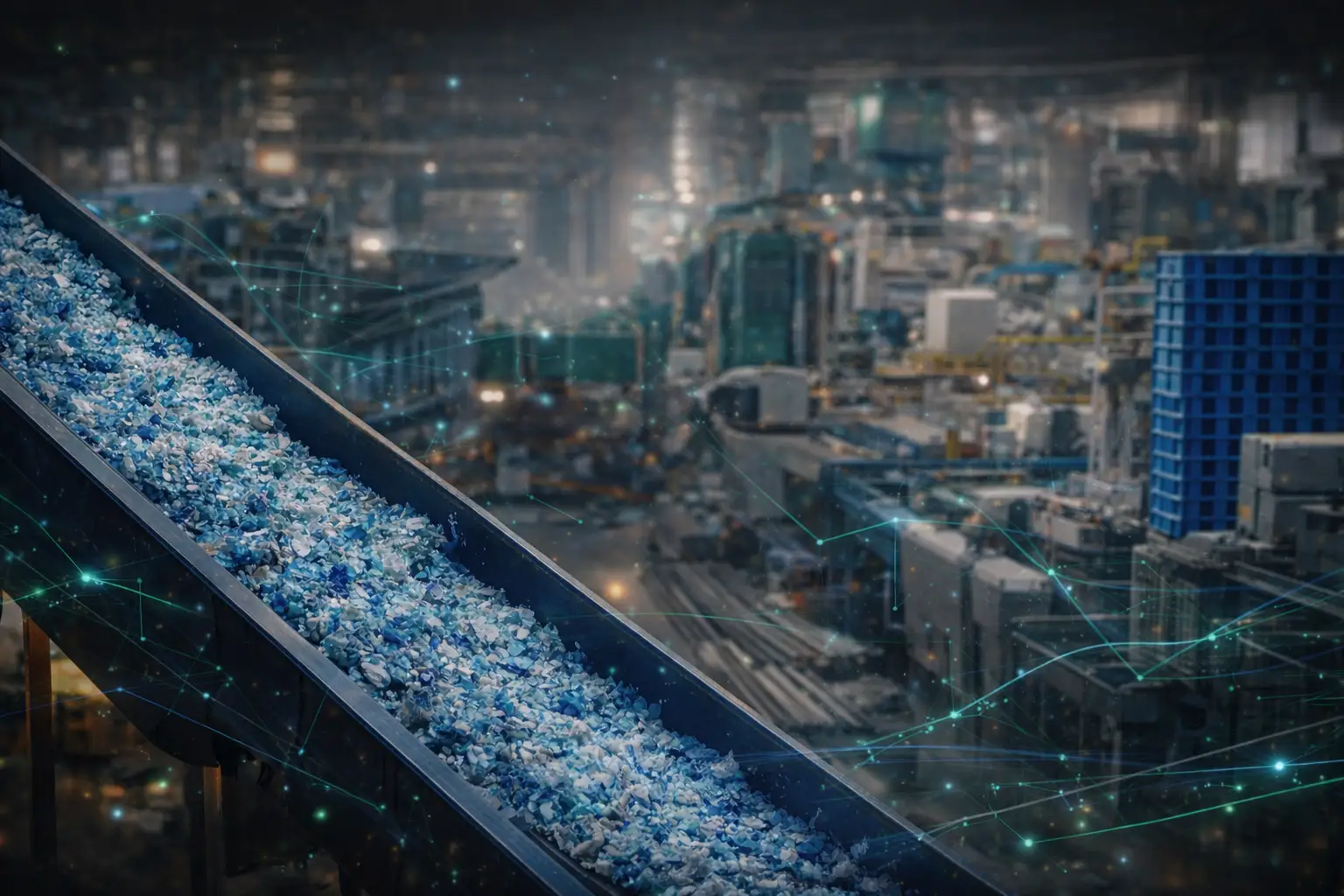

LLDPE Recycling in the USA Complete Guide to Film Scrap Regrind Pellets and PCR
Linear low density polyethylene, commonly abbreviated LLDPE, is a major material in stretch film, pallet wrap, industrial bags, liners, agricultural film, flexible packaging and selected molded products. U.S. manufacturers and commercial facilities generate edge trim, rejected rolls, start up film, bags, cores, loose wrap, baled film, purges and off specification pellets. Farms, distribution centers, retailers, construction operations and consumers create additional post use streams with very different contamination and collection economics.
LLDPE can be mechanically recycled when the source, polymer family, additives, construction and contamination are controlled. Clean post industrial film may return as regrind, densified feedstock or pellets. Post consumer film can also become PCR, but labels, adhesive, moisture, food residue, dirt, incompatible layers and collection practices can reduce usable yield. A bale described only as number 4 film does not establish that it is pure LLDPE or suitable for a particular film application.
This guide gives film producers, converters, warehouses, farms, recyclers, compounders, resin buyers and traders a practical framework for qualifying LLDPE in the United States. It explains resin differences, scrap sources, sorting, washing, drying, densification, extrusion, filtration, pelletizing, testing, pricing, freight, claims and contracts. The commercial goal is simple: turn a light, variable film stream into a documented raw material whose composition and performance a buyer can verify.
What LLDPE Is
LLDPE is an ethylene copolymer with a largely linear backbone and controlled short chain branches introduced through alpha olefin comonomers. Commercial families are often described by the comonomer used, including butene, hexene and octene grades. Resin producers also use different catalyst technologies, molecular weight distributions and additive packages. These choices influence film toughness, drawdown, seal behavior, optics, stiffness, puncture resistance, processability and price.
The name low density refers to a property range, not to one universal formula. Many conventional LLDPE grades fall around 0.915 to 0.940 grams per cubic centimeter, while very low density materials and specialty products can sit outside a simple range. Melt index, density and comonomer type are useful descriptors, but none alone proves identity or predicts performance after recycling. A buyer should qualify the actual lot and application.
LLDPE is a semicrystalline thermoplastic. It can be remelted and reshaped, which makes mechanical recycling possible, but each processing history can change oxidation, molecular weight, gels, odor and additive condition. Film performance depends on more than bulk chemistry. Layer design, orientation, thickness, slip, antiblock, tackifier, processing aids, pigments and stabilizers can materially affect a recycled blend.
Conventional LLDPE and Metallocene LLDPE
Conventional LLDPE and metallocene LLDPE, often written mLLDPE, belong to the same broad polyethylene family but should not be treated as identical grades. Single site catalyst technology can provide a narrower composition distribution and strong film toughness, seal and optical performance. Commercial mLLDPE products span different densities, flows and comonomers, so the catalyst label is not a complete specification.
Stretch and packaging films frequently combine conventional LLDPE, mLLDPE, LDPE, plastomers or other polyethylene grades to balance stiffness, holding force, puncture, clarity, seal and processing stability. A clean production roll therefore may still be a designed blend or multilayer structure. Recyclers should preserve the original film recipe or supplier grade where available instead of assuming that all clear stretch film is one homogeneous resin.
A buyer can often use mixed compatible polyethylene in a lower specification product, but the acceptable composition is application specific. Return to thin high speed film may require tighter gel, optics, odor and mechanical limits than use in a heavy liner, construction film or molded article. The contract should name the approved feedstocks rather than relying on broad terms such as PE or metallocene scrap.
LLDPE Compared With LDPE HDPE and Other Flexible Polymers
LLDPE and LDPE
LDPE has substantial long chain branching created by its production route, while LLDPE has a more linear backbone with short chain branching from comonomers. LDPE is often valued for melt strength, processing stability, clarity and shrink behavior. LLDPE is often selected for toughness, tensile strength, puncture resistance and downgauging. Film producers commonly blend them, so physical appearance alone cannot separate the two.
LDPE and LLDPE can be compatible in many recycled polyethylene applications, but the ratio changes bubble stability, extrusion load, optics, seal and mechanical behavior. A buyer producing blown film may need a controlled LDPE component for processability. Another buyer may prefer higher LLDPE content for toughness. Listings should describe known blend ratios and original application whenever records exist.
LLDPE and HDPE
HDPE normally has higher density, crystallinity and stiffness than LLDPE. It is common in bottles, crates, pipe, closures and stiff films. Small controlled amounts may be used in film formulations, but uncontrolled HDPE can change drawdown, haze, tear balance, seal response and stiffness in recycled LLDPE. Rigid HDPE pieces can also damage film handling and filtration systems.
Density separation cannot perfectly resolve all polyethylene grades because commercial density ranges and additives overlap. Pigments, fillers and multilayer constructions can shift measured values. Source records, spectroscopy, melt behavior and product knowledge should complement density testing. A mixed polyethylene pellet should be marketed as a defined recycled PE blend rather than as pure LLDPE.
LLDPE and MDPE VLDPE Plastomers or EVA
MDPE, very low density polyethylene, polyolefin plastomers and EVA can appear in flexible products beside LLDPE. Some are deliberately blended for softness, sealing, impact or flexibility. EVA contains vinyl acetate, while plastomers and very low density grades can have substantially different softness and thermal behavior. A broad infrared polyethylene result may not fully characterize these compositions.
These materials are not automatically contaminants, but they must be evaluated against the buyer’s formula. Excess soft component can reduce stiffness or blocking resistance, and EVA or tie layers can change odor, thermal behavior and filtration. The seller should identify known sealants, adhesives and specialty layers, particularly when the output is intended for demanding film or food packaging applications.
LLDPE and PP PET PA EVOH or PVC
Polypropylene film can resemble polyethylene but has different density, melting behavior and elongation. PET and polyamide provide strength or barrier in multilayer packaging yet can create gels and defects in polyethylene recycling. EVOH barrier layers, adhesives and aluminum can remain embedded after shredding. PVC requires especially strict control because chlorinated contamination can generate corrosive and hazardous decomposition products when heated.
Optical or density sorting may reduce some contamination, but thin flexible structures fold, overlap and carry labels that complicate identification. The best control is often design information and source separation before grinding. A buyer should specify permitted multilayer constructions and maximum non polyethylene content rather than accepting a generic flexible packaging description.
Resin Identification Code Four
LLDPE film is commonly associated with resin identification code 4, the LDPE family designation used on many polyethylene flexible products. The code is an identification aid. It does not guarantee that a package is collected locally, compatible with a particular recycling process, made from one polymer, or accepted by a buyer. LLDPE itself does not receive a separate number within the familiar one through seven system.
Code 4 film can include LDPE, LLDPE, blends, pigments, labels, closures, barrier layers and adhesives. Some flexible articles are unmarked, and industrial film can be known more reliably from bills of material than from an embossed code. Commercial qualification should therefore use source, construction, grade and test data. Recyclability claims must reflect an actual collection, sorting and reprocessing pathway for the product and market.
Major LLDPE Applications and Scrap Sources
Stretch Film and Pallet Wrap
Stretch film is one of the most visible LLDPE applications. Cast and blown structures can use conventional LLDPE, mLLDPE, tackifiers, cling layers, slip or other polyethylene components. Distribution centers, beverage plants, manufacturers and retailers generate hand wrap, machine wrap, roll ends, edge trim and rejected rolls. Clean commercial back of house film is generally more attractive than film mixed with tape, labels, strapping and product residue.
Used pallet wrap has very low loose bulk density and can trap paper labels, wood splinters, moisture and PP or PET strapping. Collection systems should place clearly labeled bags or cages near unwrapping points, exclude stretch hood and shrink films if the buyer requires separation, and compact only after contamination controls work. Transparent natural film usually preserves more color options than printed or mixed color wrap.
Industrial Bags Sacks and Liners
LLDPE is used in heavy duty sacks, drum and box liners, refuse bags, protective covers and shipping bags. Factory trim can be clean and consistent, while used bags may carry resin powder, food ingredients, chemicals, cement, fertilizer, pigment or hazardous residue. A recycler must understand the former contents before deciding whether the film is safe and technically suitable.
Bag features can include printing, handles, zippers, draw tapes, labels and multilayer seals. Black refuse sacks may contain variable recycled resin and fillers. A supplier should identify the original product, gauge, color, print coverage, closure and residue. Empty packaging is not automatically clean, nonhazardous or suitable for unrestricted recycling.
Agricultural Film
Agricultural LLDPE applications include greenhouse covers, silage film, bale wrap, mulch film, irrigation related film and protective liners. These products may use ultraviolet stabilizers, pigments, multilayer barriers, tackifiers and specialized mechanical designs. Collection after use can bring soil, stones, vegetation, twine, netting, moisture, fertilizer and crop protection residues. Different film types should not be combined without an outlet specification.
Agricultural film economics are dominated by contamination and transport. Wet soil can contribute more weight than usable polymer, and thin mulch film can fragment during removal. Programs should record field conditions, removal method, storage, prohibited residues, baling and seasonal volume. A buyer should estimate clean dry yield from representative loads rather than paying only on inbound gross weight.
Blown and Cast Film Manufacturing Scrap
Film plants generate edge trim, start up film, off gauge rolls, gels, color change material, skeletons, cores, roll ends and pellets. This post industrial material can be highly recyclable when each line preserves resin formula, color, print, treatment and production order. Inline edge trim may already return to the process, while external scrap needs a separate accounting and quality route.
Printing, lamination, corona treatment, metallization and adhesive can narrow the outlet. A clear unprinted monolayer roll should be segregated from a printed barrier laminate even when both contain LLDPE. The scrap tag should state the full construction, approximate layer percentages, gauge, treatment, reason for rejection and whether rework was already included in the original film.
Flexible Packaging and Sealant Layers
LLDPE and mLLDPE are widely used as sealant and toughness layers in pouches, overwrap, lidding and other flexible packaging. The finished package may also contain PET, PA, EVOH, foil, paper, inks and adhesive. Grinding converts a well defined layer structure into a composite particle. That material should be sold as multilayer flexible scrap, not pure LLDPE.
Polyethylene rich structures may have a mechanical recycling route when design, barrier percentage, adhesives, inks and end market are controlled. Compatibility guidance supports design decisions, but it does not replace an operating buyer’s specification. Food contact, odor, migration, seal and appearance requirements can make return to packaging more demanding than conversion into durable nonfood products.
Construction Film and Geomembranes
Construction sheeting, vapor barriers, protective film, pond liners and flexible geomembrane products can use LLDPE or related polyethylene grades. Clean cutoffs and installation trim may be recoverable. Used material can contain soil, concrete, sealant, adhesive, wood, metal, water and unknown chemicals. Reinforced or scrim backed structures need separate identification.
Thick sheet and geomembrane scrap may be easier to handle than thin film but can include welded seams, patches and weathered zones. The recycler should know whether the material carried potable water, wastewater, mining solution, landfill leachate or another substance. Historical use can determine both safety and end market acceptance.
Rotational Molding and Other Molded Products
LLDPE grades are also used in rotationally molded tanks, bins, toys, kayaks, barriers and industrial products. Production scrap includes powder, trimmed openings, rejected moldings and off specification parts. Pigments, foam layers, crosslinked polyethylene, inserts and previous contents can change the recycling route. Crosslinked polyethylene does not remelt like standard thermoplastic LLDPE.
A molded part should be identified through grade records and construction before size reduction. Black or colored regrind may be valuable in controlled molded applications, but flow, particle size, impact and environmental stress crack performance require qualification. Do not combine rotomolding powder or parts with film solely because both are labeled LLDPE.
LLDPE Recycling Market Context for the 2026 Edition
The U.S. LLDPE recycling market includes internal film rework, regional commercial film collection, agricultural programs, custom reclaimers, compounders and buyers of recycled polyethylene pellets. Supply and demand vary by resin price, freight, bale quality, packaging activity, agricultural season, recycled content commitments and the ability of plants to run thin flexible material. There is no single national spot price for LLDPE scrap.
Clean recurring post industrial film normally has the broadest buyer interest because its formula, color and contamination can be controlled. Clear commercial stretch film can be attractive when labels, strapping and moisture are removed. Printed, heavily soiled, multilayer or mixed color film needs more sorting and a compatible outlet. Agricultural streams can reach scale but often carry the largest yield uncertainty.
Collection announcements and pilot programs should not be mistaken for permanent capacity. Sellers need direct confirmation of current specifications, minimum volume, delivery area and operating status. Buyers need representative samples and normal production loads. A marketplace listing becomes stronger when it describes the actual film source and data rather than promising that all number 4 plastic has a ready market.
Post Industrial LLDPE
Post industrial LLDPE includes manufacturing trim, rejected film, off specification rolls, bags, purges, molded scrap and surplus resin generated before consumer use. It can retain supplier grade, lot, formulation and processing records. These streams are strong candidates for direct regrinding, densification or pelletizing when printing, cores, metal and incompatible changeover material remain controlled.
Source separation should begin at the film line or converting machine. Containers can be assigned by formula, color, print and construction. Start up material and changeovers should carry both preceding and following resin information. Floor sweepings, burned purges, paper cores and maintenance waste should not enter a clean trim stream simply because they came from the same department.
Commercial documents should distinguish internal rework, externally recycled manufacturing scrap and post consumer resin. Definitions can vary across standards, laws and customer programs. A converter should document where the material arose, who processed it, whether it returned to the same line and how the claimed percentage was calculated.
Post Consumer LLDPE and PCR
Post consumer LLDPE has completed its intended use. Sources can include used pallet wrap, agricultural film, bags, packaging and durable molded goods. PCR status describes history, not purity or fitness. The material still needs limits for polymer composition, moisture, ash, odor, color, gels, foreign matter, flow and any application specific property.
Commercial film collection often works best in concentrated settings where employees can remove labels, straps and nonfilm items before baling. Consumer flexible packaging is more complex because products are small, diverse and frequently multilayer or contaminated by food. A drop off instruction or store collection label does not guarantee that a specific local program or downstream processor accepts every flexible package.
A credible PCR system connects collection records, weights, sorting loss, washing and extrusion yield, formulation, inventory and shipped product. The percentage should be stated for the correct component or finished item. Physically recycled PCR, post industrial recycled content and mass balance attributed feedstock are different claims and should remain distinct.
Collection and Source Separation
Film collection should be designed around a confirmed buyer specification. At a warehouse, place clear bags, carts or cages near the point where pallets are unwrapped. Train employees to remove paper labels, tape, cardboard, corner boards, metal, product residue and PP or PET strapping. Keep wet outdoor film separate. Inspect collection containers daily during launch and record contamination causes.
At a film plant, use line specific containers and production tags. At a farm, separate greenhouse, silage, bale wrap and mulch film and record product and field history. At a construction site, protect clean cutoffs from mud and mixed debris. Each unit should identify generator, location, source, date range, color, known construction and net weight.
Baling improves density and freight, but it also hides contamination. A bale specification should define dimensions, target weight, tie material, allowed cores, labels, rigid pieces, moisture and prohibited contents. Photographs should show loose feedstock and representative opened bales, not only clean exterior surfaces.
Sorting and Polymer Identification
Manual sorting can remove obvious paper, strapping, rigid plastic and wrong color film when operators have practical standards. Optical sorting may support larger systems, but thin film overlaps, folds, dirt, carbon black and multilayer construction can limit detection. Air classification, ballistic separation, magnets and screens target different contaminants. No single sorter proves a pure LLDPE output.
Identification should combine supplier records, product knowledge, film construction, spectroscopy, density or thermal behavior and processing tests. Fourier transform infrared spectroscopy can screen polymer families, while differential scanning calorimetry can help characterize melting behavior. Closely related polyethylene grades and blends can remain difficult to quantify precisely, so the commercial specification should focus on performance and known source where appropriate.
Sorting performance should be measured by both purity and recovery. Rejecting too much acceptable film lowers yield, while retaining small amounts of PVC, PET, PA, paper or metal can damage output quality and equipment. Sampling should cover ordinary variability across shifts, facilities and seasons rather than one hand selected bag.
Mechanical Recycling Process
Receiving Inspection and Debaling
The receiving team should compare the shipment with the purchase specification before unloading. Seal, weight, bale condition, odor, moisture, color, visible residue, nonfilm items and source documents should be recorded. Loads with chemicals, medical waste, batteries, excessive dirt or unknown liquid require quarantine and an established response rather than routine processing.
Bales should be opened in a controlled area and sampled from multiple positions. Compression can hide wet cores, paper and rigid pieces. Tie wire or plastic strap must be removed safely. The facility should define who samples, how increments are combined, which laboratory controls disputes and how long retained samples are kept.
Size Reduction Washing and Friction Cleaning
Film shredders and wet granulators reduce material to a size suitable for washing and feeding. Flexible film can wrap shafts and bridge hoppers, so equipment design, knives and feed control matter. Prewash and friction stages can remove dirt, labels, food residue and selected adhesive. Agricultural film may require robust soil and grit removal before it reaches high wear equipment.
Wash chemistry, temperature, residence time and mechanical action should match the contamination. Caustic or detergent systems require controls for worker exposure, wastewater and residue. Washing cannot remove a barrier polymer dispersed through a multilayer film or restore oxidized resin. The process should track incoming contamination, water use, sludge, fines and clean flake yield.
Drying Densification and Agglomeration
Thin film retains water and has extremely low bulk density. Mechanical dewatering, thermal drying and controlled storage are needed before extrusion. Moisture can cause bubbles, unstable output and poor pellet quality even though polyethylene itself is not strongly hygroscopic. Entrained wash water, labels and folded film surfaces still carry moisture into the feed system.
Densifiers, compactors and agglomerators increase bulk density so film feeds more consistently. Heat and shear must be controlled to avoid oxidation, fused lumps and odor. Agglomerate should be described by source, bulk density, particle range, moisture, fines and thermal history. Densification improves handling; it does not purify a mixed stream.
Extrusion Filtration Devolatilization and Pelletizing
A recycling extruder melts and homogenizes qualified film feedstock. Screen changers capture particles larger than the selected filtration level, while vacuum venting can reduce selected moisture and volatiles. Filtration does not remove dissolved ink, odor, compatible polymer blends or very fine degradation products. The operator should track melt temperature, pressure, torque, throughput, vent condition and screen change frequency.
Pelletizing can improve feeding, blending and lot consistency. Stable pellet size, low fines, controlled moisture and clean packaging help the next processor. Samples should cover start up, steady state and the end of a run. Repeated screen pressure increases, black specks, smoke or odor can reveal contamination that was not obvious in incoming bales.
Blending Additives and Compatibilization
Recycled LLDPE can be blended with virgin LLDPE, LDPE, mLLDPE or approved modifiers to reach a target flow and property window. Antioxidants may help protect the new processing cycle. Color concentrates, odor control, mineral fillers or compatibilizers may support a defined product. Each addition changes cost, density, performance and claims and should be recorded.
A compatibilizer can improve selected mixed polymer systems, but it cannot turn unknown waste into a predictable food, film or pressure application. Stabilizers do not remove contamination or reverse severe molecular damage. The compounder should qualify the full formulation at the intended percentage and use change control when feedstock, recipe or supplier changes.
Contaminants That Reduce LLDPE Value
Common contaminants include PP and PET strapping, HDPE rigid pieces, PVC, PA, PET and EVOH barrier layers, paper, cardboard, wood, metal, glass, labels, adhesive, tape, ink, aluminum, food, oil, chemicals, sand, soil and moisture. Their impact depends on concentration, particle size, distribution, processing temperature and intended application.
Agricultural film can carry abrasive soil and biological residue. Commercial stretch wrap can contain shipping labels, corner board fragments and mixed pallet straps. Printed packaging can introduce odor, color and volatile products. Construction film can carry concrete and sealant. One contamination limit cannot describe all these risks, so the specification should name the source and prohibited materials explicitly.
Filtration captures only particles larger than the screen opening and may cause pressure instability when loads are dirty. Washing targets surface contamination but cannot separate every bonded layer. Dark color can hide specks without correcting composition. Source controls, sorting, washing, analytical screening and production trials must work together.
Odor Ink Color Gels and Surface Defects
High quality film applications can be limited by odor, gels, fisheyes, black specks and color variation long before bulk tensile properties fail. Odor can arise from previous contents, food, ink, adhesive, oxidation or overheating. A masking fragrance is not equivalent to removing the source. Sensory evaluation needs controlled conditioning, containers, panel procedure and acceptance rules.
Printed and mixed color film usually returns as gray, green, brown or black compounds unless the buyer has another controlled route. Natural clear feedstock preserves the most color flexibility. Instrumental color data can support pellet comparison, while a blown film trial reveals haze, specks and gels that pellet photographs do not show.
Gel count depends on filtration, degradation, crosslinked material, incompatible polymers and test film conditions. The parties should define film thickness, die, screen pack, imaging area and defect size classes. A recycled pellet can meet melt flow and still fail a thin film because a small number of hard gels produces holes or visible defects.
Quality Specifications and Testing
An LLDPE purchase specification should identify source, original product, known grade or formulation, post industrial or post consumer history, color, printing, construction, physical form, previous processing and allowed blends. It should define lot, sampling, packaging, units, test conditions, limits, change notification and intended use. The exact version of each method should match the buyer’s current quality plan.
Common controls include polymer identification, melt mass flow rate, density, moisture, ash, bulk density, contamination, color, odor, volatiles, gel count and pellet dimensions. Film applications may add tensile properties, elongation, tear, dart impact, puncture, haze, gloss, coefficient of friction, blocking and seal behavior. ASTM D1238 supports melt flow testing, ASTM D792 density, ASTM D882 tensile testing of thin sheeting, ASTM D1709 dart impact and ASTM D1922 propagation tear under stated conditions.
Test results are condition specific. Melt flow changes with temperature and load, while film tensile values depend on direction, thickness and specimen preparation. Density cannot distinguish every LLDPE blend. A certificate of analysis must identify the released lot, method and units. Representative production trials remain essential when recycled resin enters thin film, automatic packaging or a critical application.
| Control item | Recommended lot description | Commercial purpose |
| Polymer and construction | LLDPE grade or approved PE blend with monolayer or multilayer description | Prevents false identity and incompatible routing |
| Source and history | Plant product application and PIR or PCR collection channel | Predicts additives residue and normal variability |
| Color and print | Natural clear mixed color black and print coverage | Defines appearance options and ink load |
| Control item | Recommended lot description | Commercial purpose |
| Flow and density | Method conditions units target and tolerance | Supports feeding processing and blend control |
| Moisture and ash | Sampling preparation method and maximum values | Controls water dirt filler and inorganic residue |
| Foreign material | Limits for paper metal wood rigid plastic straps and prohibited polymers | Protects equipment yield and film quality |
| Odor and gels | Conditioning panel or film trial with defect size classes | Protects packaging and thin film performance |
| Mechanical film data | Thickness direction tensile tear dart puncture and seal conditions | Connects pellets with intended product performance |
| Physical form | Rolls bales loose film flake agglomerate regrind pellets or purges | Defines handling sampling and freight |
| Sampling and change control | Increment plan retained sample and notice for source recipe or process change | Makes approval repeatable and disputes traceable |
Sampling and Lot Release
Film scrap segregates by color, thickness, moisture, label content and container depth. Bales can have a clean exterior and a wet or contaminated core. Regrind fines settle, and pellets from start up can differ from steady production. The sampling plan should define the number and location of increments, composite mass, preparation, retained sample and decision rules.
Lot release should compare documents, packaging, appearance, odor, moisture, ash, contamination and laboratory results with the approved specification. Film buyers may require a small extrusion screen test or blown film evaluation. Nonconforming material needs a defined hold, resort, downgrade, return or disposal route before it can mix with approved inventory.
Production Trials for Recycled LLDPE
A laboratory pellet result does not replace a normal production trial. The buyer should run representative material at the intended recycled percentage and record feeding, melt temperature, pressure, motor load, filtration, bubble or web stability, gauge control, output and scrap rate. Finished film should be evaluated in machine and transverse directions at the intended thickness.
Trial criteria should reflect the product. Stretch film may require holding force, puncture, cling and unwind performance. Bags and liners may prioritize seal strength, dart impact and tear. Agricultural film can require durability and weathering appropriate to use. Printed packaging may add odor, optics, ink adhesion and converting performance. Approval should link supplier, source, lot, formulation, percentage, process and final application.
Forms of LLDPE Traded in the United States
Loose Film Rolls and Roll Stock
Loose film and rejected rolls preserve visual evidence of color, printing and construction. Listings should state grade or formula, application, gauge, width, roll weight, cores, treatment, print, multilayer structure and reason for rejection. Telescoped, wet or crushed rolls may need different handling from clean off specification inventory.
Loose used stretch wrap is inexpensive to collect but costly to transport. Sellers should report how it is stored and whether labels, tape and straps are removed. Photos should show a normal container and close view. Buyer and seller should agree whether paper cores, pallets and packaging are deducted from net weight.
Baled LLDPE Film
Bales support truckload density and are common for commercial film and agricultural recovery. A bale specification should identify source, film types, color, dimensions, target weight, tie, moisture, allowed labels and maximum nonfilm content. A warehouse stretch film bale is a different feedstock from a mixed retail bag bale or soil covered agricultural bale.
Inbound bale inspection should include weights, photos, opened bale samples and clean dry yield on representative loads. Seller prepared samples should not replace routine sampling. Price adjustments can use agreed contamination or yield brackets, but the measurement method and responsible party must be written before shipment.
Flake Regrind Agglomerate and Densified Feedstock
Washed flake, dry regrind and agglomerate offer higher bulk density than loose film. Listings should state source, wash status, particle range, fines, bulk density, moisture, ash, color, odor, metal control and previous thermal history. The word clean should be supported by a defined method and limit.
Agglomerate can bridge or feed irregularly if size and bulk density vary. Regrind may still contain folded labels and multilayer fragments. Buyers should test normal production material in the intended feeder and extruder. A screen test can reveal contamination that is not visible in a small jar sample.
Recycled LLDPE Pellets and Compounds
Pellets can provide more consistent feeding, filtration and sampling. A data sheet should state feedstock source, recycled content category, formulation, color, melt flow, density, moisture, ash, contamination, odor, gel evidence and intended applications. Natural pellets made from clear controlled film differ commercially from mixed color PCR pellets.
A compound may intentionally combine LLDPE, LDPE, mLLDPE, color, filler or modifiers. It should be sold under the actual formulation or performance grade rather than as pure LLDPE. Buyers should qualify the product at its intended addition rate and require notice before feedstock, recipe, stabilizer or processing conditions change materially.
Purges Lumps and Off Specification Resin
Purges and lumps can include oxidized surfaces, metal, several colors, cleaning compound and polymers from line changeovers. Their value depends on whether useful sections can be cut and identified safely. A named LLDPE purge listing should disclose the preceding and following materials, purge method and presence of burned zones.
Off specification pellets and rolls may be highly recoverable when the failure is documented. A color or gauge deviation has a different risk from contamination, odor, wrong additive or failed food packaging requirement. Confidential branded film may require controlled destruction and traceable recycling terms.
What Determines LLDPE Scrap Price
LLDPE scrap value rises with verified source, natural color, low contamination, recurring volume, high usable yield, useful physical form and proximity to a qualified buyer. Clean post industrial edge trim and rolls often preserve more options than mixed post consumer film. Washed and pelletized material may command a higher unit price but includes more processing, yield loss, energy and quality responsibility.
A buyer can estimate netback from the value of qualified pellet or finished compound, then subtract collection, baling, freight, sorting, washing, drying, densification, extrusion, filtration, testing and residual disposal. Pay weight is not the same as usable polymer. Water, soil, paper, cores and rejected film should be covered by an agreed deduction or clean dry yield method.
Quotes should state date, origin, monthly quantity, minimum lot, packaging, weight basis, specification, inspection, delivery term and price adjustment. Virgin and recycled polyethylene markets move, but formula pricing should use a transparent reference and adjustment period. WASTEMARKT listings become easier to compare when sellers provide source, form and test data rather than one undifferentiated per pound number.
Packaging Storage and Freight
Loose film should move in closed bags, cages or boxes that prevent wind loss and contamination. Bales need stable dimensions, sound ties and safe stacking. Flake, agglomerate and pellets require clean lined packaging suited to dust and moisture control. Each unit should identify supplier, material, color, source, lot and net weight.
Film stored outdoors can collect water, dirt and ultraviolet exposure, creating both quality and weight disputes. Agricultural film should be protected after removal rather than placed in standing water. Pellets create slip hazards, and grinding or pneumatic handling can produce dust. Storage areas need housekeeping, segregation and fire protection appropriate to the actual material form.
Freight comparisons should use delivered usable cost. Loose wrap can cube out a trailer before weight is economical, while dense bales or pellets improve payload but add processing cost. Backhaul, dock access, loading equipment, pallet condition, distance and rejected yield should be included. Weight tickets, seals, bills of lading and loading photographs support traceability.
Environmental Health and Safety Controls
Solid LLDPE film and pellets differ from the chemicals used to manufacture resin, but hot polymer, rotating equipment, dust, additives and contaminated packaging create real workplace hazards. Facilities should evaluate machine guarding, lockout, hot surfaces, fumes, ventilation, noise, slips, lifting, fire protection, personal protective equipment and emergency response for the specific process.
OSHA notes that finely divided combustible materials, including plastics, can become explosible when suspended in air under appropriate conditions. Dust behavior depends on material, particle size, moisture, concentration and equipment. Granulators, fines handling, dust collectors and conveying systems require a site specific hazard assessment and disciplined housekeeping.
Former contents are a critical receiving question. Agricultural chemicals, industrial powders, oils, food residue and medical or hazardous material can require special controls or rejection. Washing creates wastewater and sludge that must be characterized and managed. Operators should follow current safety data, exposure guidance and federal, state and local requirements.
Recycled Content and Recyclability Claims
A recycled content claim should identify the percentage, source category, calculation method and product component covered. Post industrial and post consumer material should remain distinct, and internal rework may be treated differently by a customer or standard. Physical PCR, mass balance attributed recycled feedstock and bio attributed polyethylene are separate commercial concepts.
Purchase records, incoming weights, contamination removal, process yield, recipes, inventory and shipped product should reconcile. Third party certification can support chain of custody when scope and site match the claim, but it does not prove local collection, film performance, food contact suitability or compliance with every customer program.
FTC guidance expects environmental marketing claims to be truthful, specific and supported. A recyclable claim should account for collection, sorting and processing access for the actual product, not only the theoretical ability to remelt polyethylene. Flexible packaging construction, labels and local acceptance can change the answer even when an item carries code 4.
Yield and Mass Balance
A physical mass balance begins with received net weight and records packaging, moisture, dirt, labels, paper, rigid plastic, wash residue, water, fines, filtration waste, rejected pellets and usable output. Boundaries and measurement methods should be defined. A bale can look inexpensive until clean dry polymer yield and residual disposal are known.
Yield data supports both pricing and collection improvement. A distribution center can trace contamination to one dock or shift. A farm program can compare removal and storage methods. A film plant can identify the line or order that introduced a barrier structure. Attributed feedstock accounting should remain separate from the physical material balance of a recycling run.
Food Contact and Product Compliance
Recycled polyethylene does not automatically inherit the regulatory or customer status of the original film. Food packaging use requires an appropriate safety and compliance assessment for the source, recycling process, contaminant controls, conditions of use and finished article. FDA guidance on recycled plastics and any applicable review should be evaluated by qualified regulatory professionals.
Agricultural, construction, medical, child product and industrial applications can impose additional chemical, mechanical or traceability requirements. A successful extrusion trial does not establish compliance. The new product manufacturer remains responsible for the actual formulation, recycled percentage, additives, processing, testing, labeling and intended conditions of use.
Material status in transport and storage depends on source, contamination, handling and applicable law. The word scrap does not determine whether a shipment is a product, recyclable material or waste. Generators and receivers should verify permits, records and facility acceptance before domestic or international movement.
How a Factory or Warehouse Can Build an LLDPE Recycling Program
Begin with a thirty day audit. Record every film source, resin or construction, color, print, gauge, monthly weight, contamination, current disposal cost, storage and potential outlet. Identify where stretch wrap is mixed with tape, labels, cardboard, strapping, food or wet material. Choose one clean recurring stream for the first qualification.
Place labeled collection equipment at the point of generation and give operators short accepted and prohibited material standards. Weigh containers, photograph deviations and provide a quarantine route. Decide whether baling at the site is justified by volume, labor and buyer specifications. Keep production film separate from post use commercial wrap unless the buyer approves a blend.
Send a representative sample and data sheet to qualified recyclers. Compare collection equipment, freight, clean dry yield, washing, filtration, testing, residual management and claims evidence. Run a normal load before signing a long contract. Review contamination, weights and buyer feedback monthly and expand only after the stream remains within specification.
Agricultural Film Program Design
An agricultural program should map film product types, brands, field uses, seasons, acreage, removal methods and storage locations. Mulch film, greenhouse cover, silage wrap, bale netting and irrigation components should have separate rules. The program should define whether residual chemicals, treated seed bags, twine, PVC hose and heavily soil loaded film are prohibited.
Collection timing matters. Dry conditions and prompt shelter can reduce water and biological contamination. Mechanical removal may improve labor efficiency but can add soil or tear film into fragments. A pilot should weigh incoming material, contamination and clean output from several representative farms. Education, photos and feedback are necessary because one dirty load can reduce the value of a larger regional batch.
A program should confirm legitimate processing and residual outlets before collection. Seasonal volume, bale storage, fire protection, transport and cash flow must be planned. Claims should describe what was actually collected and recycled, not the amount offered or announced. Farm participants need clear documentation of fees, rejected loads and former content responsibilities.
Buyer Qualification From Sample to Repeat Orders
The initial inquiry should cover polymer, original application, monolayer or multilayer construction, grade or recipe, color, print, PIR or PCR history, contamination, form, quantity, frequency, location and packaging. Photographs and records support screening. A representative composite sample then allows the buyer to select relevant analytical and processing tests.
The pilot lot should use normal collection and packaging rather than specially cleaned material. The buyer records receiving condition, sorting time, clean dry yield, wash behavior, moisture, filtration pressure, odor, pellet quality and finished product performance. The written specification should cover sampling, methods, price adjustment, rejection, retained samples and change notification.
Repeat orders depend on consistency and disclosure. A new supplier resin, film layer, ink, adhesive, collection site or agricultural season can change performance. Certificates should connect to shipment lots. The buyer should not assume that all clear stretch film or all number 4 film matches the approved sample.
Domestic and International Trade
Domestic LLDPE trade often favors regional routes because low density film is freight sensitive and contamination can make long movements uneconomic. Aggregators can build scale only when source categories, color and quality remain controlled. A buyer should compare delivered usable polymer cost, not the lowest free on board price.
International transactions require an agreed material description, specification, inspection plan, packaging, loading method, payment, customs classification and destination acceptance. Contracts should address rejected cargo, contamination, weight differences, demurrage and changes in law. Documents must describe the actual film or recycled product rather than a vague label such as plastic waste.
Container photographs, net weights, seal numbers and retained samples support traceability. Export should not replace technical qualification or a legitimate residual management plan. Both parties should confirm that the destination can legally receive and process the shipment before booking freight.
Supplier and Buyer Due Diligence
Supplier review can cover legal identity, source ownership, collection controls, quality system, capacity, permits, subcontractors, insurance and claims history. Buyer review should confirm that the receiving facility can process the material, manage wastewater and residuals and produce the stated output. A site visit or video audit can compare written procedures with normal operations.
Technical diligence examines sorting, washing, drying, densification, extrusion, filtration, laboratory capability, odor control, lot traceability and change management. PCR and food packaging claims need evidence that matches the product, facility and commercial scale. A sample pellet and a marketing deck do not prove recurring capacity.
Contracts should define material, source, weights, sampling, tests, acceptance, price basis, delivery, title and risk transfer, confidentiality, claims, rejection and change control. Long commitments should follow demonstrated normal loads. Buyers and sellers should understand who owns contaminated residuals and who bears cost when clean dry yield falls below the agreed level.
State Opportunities for LLDPE Recycling
LLDPE opportunities follow film conversion, warehousing, food and beverage distribution, agriculture, construction and ports. The table gives prospecting themes rather than guaranteed outlets. Every lead requires direct confirmation of film type, volume, buyer specification, permitting, testing and freight.
| State | Likely source sectors | Program focus |
| Texas | Distribution petrochemicals film conversion agriculture and construction | Commercial stretch film Gulf logistics and large generator programs |
| California | Produce agriculture distribution packaging and consumer goods | Agricultural film source control PCR evidence and product compliance |
| New York | Retail distribution food processing construction and institutions | Back of house film aggregation and Northeast freight |
| Florida | Produce horticulture tourism distribution construction and ports | Moisture control greenhouse film and commercial wrap |
| Georgia | Film manufacturing logistics food beverage and agriculture | Plant trim warehouse collection and Southeast routes |
| Illinois | Distribution food processing converting and manufacturing | Recurring commercial film and Midwest aggregation |
| Ohio | Manufacturing converting warehousing and consumer products | Production scrap quality control and regional pellet markets |
| New Jersey | Distribution food pharmaceutical packaging and ports | Label control traceability and Northeast logistics |
| Michigan | Automotive supply manufacturing distribution and agriculture | Industrial liners commercial wrap and consistent loads |
| Louisiana | Petrochemicals industrial packaging agriculture construction and ports | Former contents review Gulf freight and weather protection |
How WASTEMARKT Supports LLDPE Transactions
WASTEMARKT can connect film producers, converters, warehouses, farms, retailers, construction companies, recyclers, compounders, resin buyers, laboratories, machinery suppliers and logistics providers. Structured listings help buyers distinguish natural production rolls from commercial stretch film, dirty agricultural film, multilayer packaging, agglomerate and tested PCR pellets.
Sellers should include polymer and known grade, original application, monolayer or multilayer construction, color, print, PIR or PCR history, physical form, contamination, test data, monthly quantity, location, packaging and delivery basis. Buyers can publish requirements using the same fields and name the intended application and recycled content percentage.
Related WASTEMARKT categories can support balers, shredders, washers, dryers, densifiers, extruders, screen changers, pelletizers, laboratory testing, freight and warehousing. The parties remain responsible for technical approval, safety, permits and contracts. Complete listings let qualified counterparties screen opportunities faster and reduce avoidable sample and freight costs.
Checklist for Sellers
Identify the film through supplier records, bills of material, production orders, product history and representative testing. Separate natural clear from printed and mixed color material. Keep PP or PET straps, paper, cardboard, metal, rigid plastic, PVC, food, soil, chemicals, wet film and burned purge outside clean streams. Photograph normal material before baling or grinding.
State net weight, frequency, location, physical form, bulk density or bale dimensions, packaging and loading method. Attach relevant melt flow, density, moisture, ash, contamination, odor, gel and trial data and explain sampling. Disclose multilayer construction and former contents. Use precise PIR, PCR, mass balance, food contact and recyclability language.
Checklist for Buyers
Define accepted LLDPE grades, sources, film constructions, colors, printing and contamination limits. State prohibited polymers, analytical methods, flow condition, density, moisture, ash, odor, gels, mechanical properties, packaging and lot size. Explain the intended product so the seller can judge fit.
Inspect a representative sample and a normal pilot load. Measure clean dry yield and process the material at the intended recycled percentage. Calculate delivered usable cost after sorting, washing and residuals. Put sampling, change notification, price adjustment, rejection, dispute and claims rules in the purchase terms.
Frequently Asked Questions About LLDPE Recycling
What does LLDPE mean ?
LLDPE means linear low density polyethylene. It is an ethylene copolymer with controlled short chain branching and is widely used in stretch film, bags, liners, agricultural film and flexible packaging.
Can LLDPE be recycled ?
Yes. Clean identified LLDPE can be sorted, washed when necessary, dried, densified, extruded, filtered and pelletized for qualified applications. Commercial access depends on source, construction, contamination, quantity and buyer specifications.
Is LLDPE the same as LDPE ?
No. Their molecular branching and processing behavior differ, although both are polyethylene and are often blended in film. A recycled blend should be qualified for the intended process and product.
Is LLDPE the same as HDPE ?
No. HDPE is generally denser and stiffer. LLDPE is widely selected for flexible film toughness and puncture resistance. Uncontrolled HDPE can alter film processing, sealing and mechanical behavior.
What recycling code is LLDPE ?
LLDPE is commonly associated with resin identification code 4, the LDPE family. The code does not prove pure LLDPE, local collection, compatibility or recyclability for a specific product.
What is metallocene LLDPE ?
Metallocene LLDPE is a family produced with single site catalyst technology. Commercial grades vary widely and can provide strong toughness, sealing and optics. The name alone is not a complete quality specification.
Can stretch film be recycled ?
Clean commercial stretch film often has a recycling route when labels, tape, cardboard, strapping, food and moisture are controlled. Collection should follow a confirmed buyer specification.
Can agricultural film be recycled ?
Yes, through qualified programs, but soil, stones, vegetation, moisture, chemicals, netting and mixed film types can reduce yield. Source separation and clean dry yield measurement are essential.
Can LLDPE and LDPE film be mixed ?
Often they can be used together in a buyer approved polyethylene formulation. The ratio affects bubble stability, drawdown, optics, seal and toughness, so the blend must be disclosed and tested.
Can multilayer packaging be sold as LLDPE ?
Only if it is described accurately. Packaging with PET, PA, EVOH, foil, paper, adhesive or other layers is multilayer flexible scrap, even when LLDPE is the main sealant layer.
What LLDPE scrap usually has the highest value ?
Clean recurring natural post industrial edge trim, rejected rolls and single formula film usually preserve the most value because color, composition and contamination are controlled.
What contaminants reduce LLDPE film value ?
Paper, labels, adhesive, tape, PP and PET straps, rigid plastics, PVC, PA, PET, EVOH, metal, wood, dirt, soil, food, oil, chemicals, water and degraded purge can reduce yield or block an application.
How is LLDPE film recycled ?
Typical steps include receiving, debaling, sorting, shredding, washing if required, friction cleaning, drying, densification, extrusion, filtration, devolatilization, pelletizing and lot testing.
What tests are useful for recycled LLDPE ?
Useful controls include polymer identification, melt flow, density, moisture, ash, contamination, odor, color, gels and film tests such as tensile, tear, dart impact, puncture, haze and seal performance.
Can recycled LLDPE return to stretch film ?
It may be possible with tightly controlled feedstock, filtration and qualification. Thin high performance film can have strict gel, optics, odor, process stability and mechanical requirements, so a normal production trial is necessary.
Is LLDPE film suitable for curbside bins ?
Acceptance varies by local program and product construction. Flexible film can tangle equipment and may require a separate commercial or drop off route. Follow current local instructions rather than relying only on code 4.
Can recycled LLDPE be used in food packaging ?
Not automatically. The source, recycling process, contaminant controls, conditions of use and finished article require an appropriate food contact safety and regulatory assessment.
How should LLDPE scrap be packaged ?
Use clean closed bags, stable bales, lined gaylords or bulk packaging suited to the form. Each unit should identify supplier, material, source, color, lot and net weight and should protect against water and dirt.
What determines the price of LLDPE scrap ?
Source, color, construction, contamination, moisture, form, volume, consistency, clean dry yield, processing cost, freight, virgin resin conditions and buyer demand determine net value.
How can WASTEMARKT help trade LLDPE ?
WASTEMARKT lets sellers list film rolls, bales, regrind, agglomerate, pellets and PCR with detailed specifications and lets buyers publish matching requirements. Sampling, qualification, permits and contracts remain essential.
Conclusion
LLDPE recycling works best when film stays connected to a known source, construction and application. Clean plant trim, rejected rolls and well managed commercial stretch film can support mechanical recycling. Agricultural and consumer film require stronger collection, washing, yield control and proof that the output meets its new application.
Buyers and sellers should define polymer blend, film layers, color, print, moisture, ash, contamination, odor, gels, test methods, usable yield and commercial terms before shipping. A detailed WASTEMARKT listing turns a light and variable film stream into a documented opportunity that a qualified recycler or compounder can evaluate.
BUY | SELL | CONNECT
List LLDPE film rolls bales regrind agglomerate pellets compounds and PCR products on WASTEMARKT
Register and add your offers at www.wastemarkt.com


